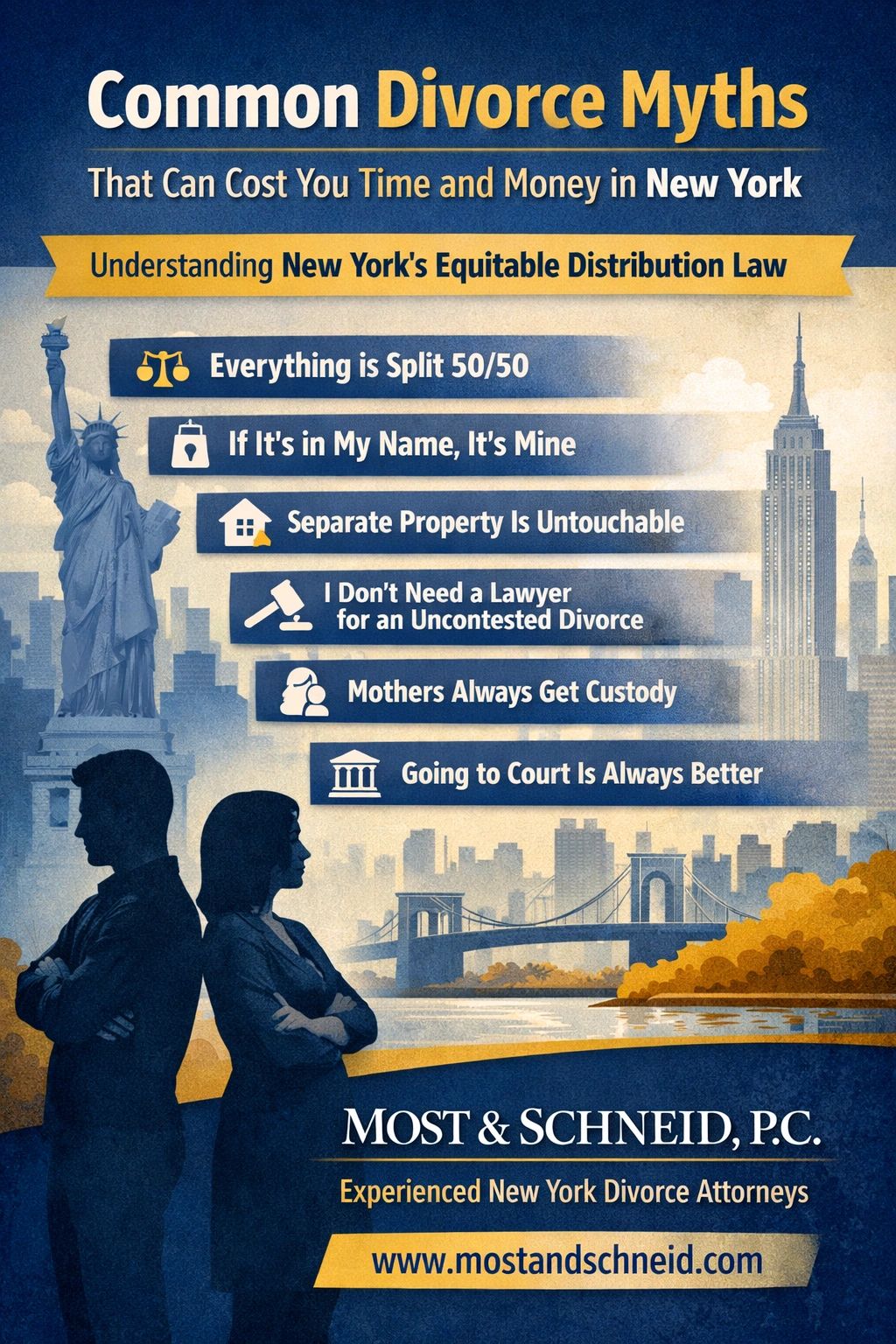
Understanding New York's Equitable Distribution Divorce Law
By: Adam Schneid, Esq.
Divorce is challenging enough without misinformation adding unnecessary cost and delay. Many people entering the divorce process rely on advice from friends, online forums, or television—only to learn that much of that information does not apply under New York divorce law.
One critical fact sets New York apart: New York is an equitable distribution state, not a community property state. This distinction directly affects how marital property, businesses, income, and other assets are divided in a New York divorce.
Below are some of the most common New York divorce myths—and what the law actually says.
Myth #1: New York Divorce Means Everything Is Split 50/50
One of the most widespread misconceptions about equitable distribution in New York is that marital assets are always divided equally.
While assets are most commonly distributed equally, New York law does not require a strict 50/50 split. Instead, courts divide marital property equitably, meaning fairly, based on the circumstances of the marriage and the type of asset involved.
When determining equitable distribution, New York courts consider factors such as:
- Length of the marriage
- Each spouse's income and property
- Contributions as a wage earner or homemaker
- Future earning capacity
- Age and health of the parties
- Wasteful dissipation of marital assets
- And other relevant factors
Certain assets—particularly closely held businesses and professional practices—are frequently divided unevenly. Courts often award the business to the operating spouse and compensate the other spouse through a distributive award or other assets. As a result, individual assets may be divided unequally even when the overall division is fair.
While equally dividing assets is the most common asset division, it is not always the case. Assuming that every asset will be split down the middle can lead to unrealistic expectations and costly litigation.
Myth #2: If It's in My Name, It's Mine Under New York Law
In a New York divorce, ownership is not determined by whose name appears on an asset.
Most property acquired during the marriage—regardless of title—is considered marital property and subject to equitable distribution. This includes:
- Bank and investment accounts
- Retirement assets and pensions
- Real estate
- Business interests
This misconception often surprises spouses who believe individually titled assets are exempt from division.
Myth #3: Separate Property Is Always Protected in a New York Divorce
New York law recognizes separate property, including assets owned before marriage, inheritances, and third-party gifts. However, separate property can lose its protected status.
Separate assets may become marital through commingling, such as placing inherited funds into an account that also contains marital property. Separate assets may become marital through transmutation by placing a spouse's name on the account (the law assumes donative intent subject to this presumption being rebutted).
Even where assets remain separately titled and not commingled, the active appreciation of separate property during the marriage may be subject to equitable distribution.
Understanding the difference between marital and separate property is essential in any New York divorce case.
Myth #4: I Don't Need a Lawyer for an Uncontested Divorce in New York
Even an uncontested divorce in New York must comply with state law and court requirements.
Agreements addressing equitable distribution, spousal maintenance, child support, and custody can have lasting financial and legal consequences. Many people discover too late that correcting an improperly drafted agreement costs far more than obtaining legal advice upfront. Risks here can include an agreement being vacated in the future or prevent an agreement from being enforced when someone refuses to comply.
Myth #5: Going to Court Will Lead to a Better Divorce Outcome
Litigating a New York divorce is often expensive and time-consuming. Court involvement frequently increases legal fees, prolongs the process, and escalates conflict—particularly when children or complex assets are involved.
In many cases, negotiation or mediation allows parties to reach an outcome consistent with New York's equitable distribution law while retaining greater control over the result. Whether court is required is a fact specific inquiry.
Myth #6: Mothers Automatically Get Custody in New York
New York courts determine custody based on the best interests of the child, not the gender of the parent.
Judges evaluate caregiving history, stability, parental cooperation, and the child's needs. Assuming custody is guaranteed can lead to poor preparation and unfavorable outcomes. There has been a steady push towards an equal division of time between the parents. This is even true where one parent was a stay-at-home parent. Many factors go into this analysis.
Myth #7: If We Agree, the Court Will Automatically Approve It
Although New York courts encourage settlement, they will not approve agreements that are unfair, incomplete, or inconsistent with New York law—especially when children are involved.
An agreement must be properly structured to be enforceable and protective of both parties' rights.
The Bottom Line: Understanding New York Equitable Distribution Matters
Misunderstanding New York's equitable distribution divorce law often leads to unrealistic expectations, unnecessary disputes, and costly mistakes. Accurate information—and experienced legal guidance—can significantly affect both the process and the outcome of your divorce.
Speak with a New York Divorce Lawyer at Most & Schneid, P.C.
If you are considering divorce or are already involved in a New York divorce matter, the attorneys at Most & Schneid, P.C. help clients protect assets, resolve disputes, and navigate equitable distribution with clarity and confidence.
Learn more or schedule a consultation at https://mostandschneid.com/
For a related look at how a spouse's conduct can affect asset division in more extreme cases, see Sexually Transmitted Infection — Domestic Violence in a Divorce.
Disclaimer
This article is for general informational purposes only and does not constitute legal advice. Reading this article does not create an attorney-client relationship. Divorce laws and outcomes vary based on individual circumstances. Consult a qualified New York divorce attorney regarding your specific situation.