by Adam Schneid
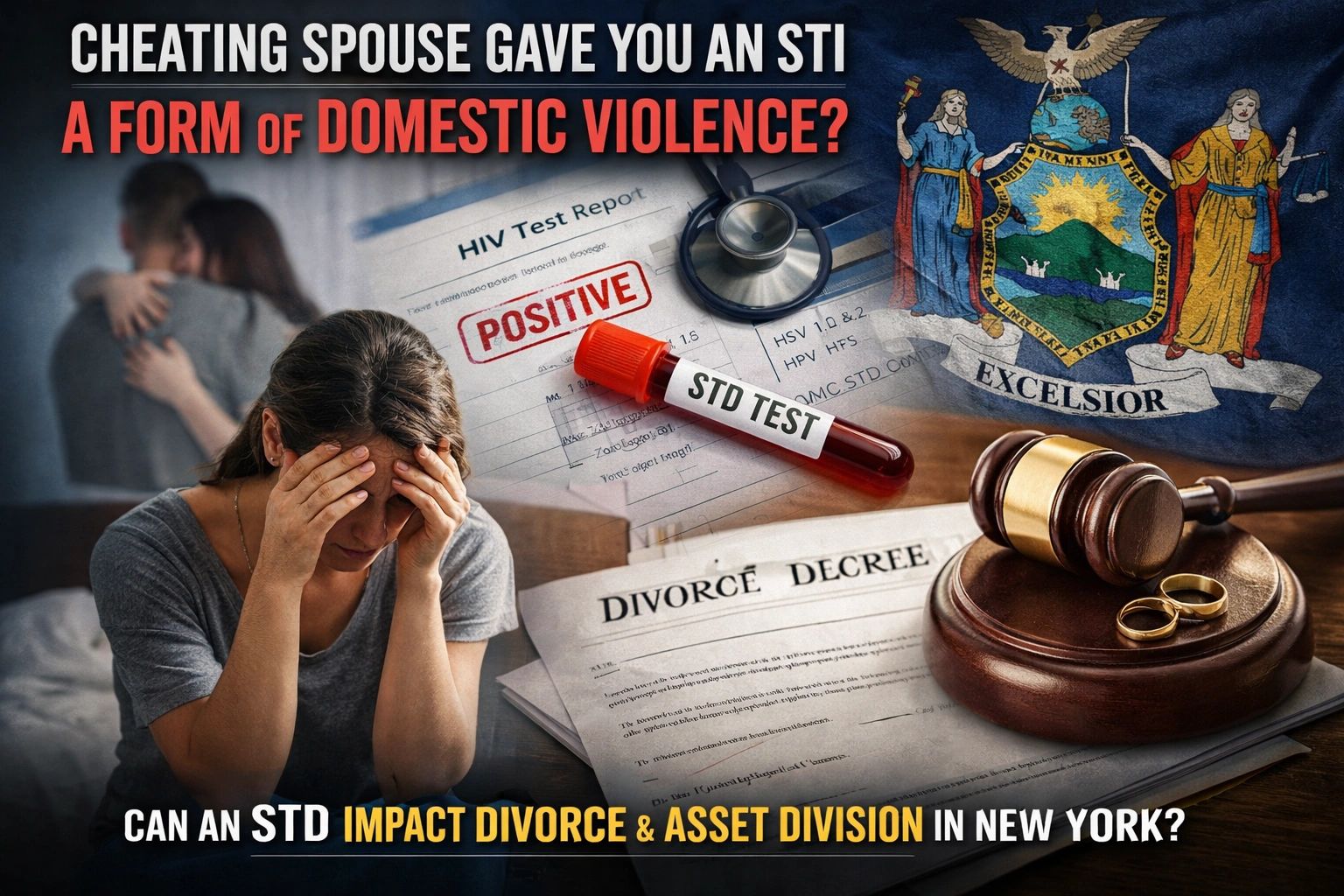
Can giving your spouse an STI or STD affect divorce and asset division in New York? A recent Nassau County Supreme Court decision suggests the answer may be yes — under the right circumstances.
In N.S. v. T.S. (2025 NY Slip Op 51897(U)), the court held that knowingly transmitting a sexually transmitted infection (STI) to a spouse can constitute domestic violence under New York law. That finding played a significant role in the court's decision to award the wife 100% of the marital estate.
For spouses considering divorce, and for those already involved in New York divorce and family law proceedings, the case provides important guidance on how domestic violence, bodily harm, and marital conduct intersect with equitable distribution.
Transmitting an STI as Domestic Violence Under New York Law
The most significant aspect of N.S. v. T.S. is the court's explicit legal conclusion that transmitting an STI may qualify as domestic violence — not merely adultery or marital fault.
The court found that the husband transmitted HSV-1, HSV-2, and HPV, causing:
- permanent medical conditions requiring ongoing treatment,
- surgical intervention for cancerous cells, and
- lasting physical and emotional harm.
The decision reinforces that domestic violence is not limited to physical assault. Conduct that causes serious bodily injury, violates bodily autonomy, and results in long-term medical consequences may fall within New York's domestic-violence framework — even within a marriage.
Generally the domestic violence must be substantial to impact the division of assets. Routine verbal arguments and name calling generally won't impact the division of assets. Similarly, isolated incidents of domestic violence consisting of a push, shove or threat without injuries generally do not result in an uneven division of assets. Nonetheless, such conduct might still influence a court and still the outcome even if a court does not expressly tie the conduct to the financial impact.
This analysis directly affects cases involving orders of protection, domestic violence findings, and financial consequences in divorce, all of which are central to Most & Schneid's family-law practice.
Why Domestic Violence Matters in Equitable Distribution
New York follows equitable distribution, not automatic 50/50 division. Courts must weigh multiple statutory factors when dividing marital property, including domestic violence.
Once the court determined that the husband's conduct constituted domestic violence, it was legally required to consider:
- the severity of the harm,
- the long-term medical and economic impact on the injured spouse, and
- whether an equal division of assets would be unjust.
This analysis sits at the intersection of property division, financial issues in divorce, and domestic violence litigation, areas that frequently overlap in contested matrimonial matters.
What Actually Drove the Court's Decision
Despite attention-grabbing headlines, the decision makes clear that the result was driven by the totality of the circumstances, not by STI transmission alone.
New York courts rarely award one spouse 100% of the marital estate. The outcome here reflects an extreme factual record rather than a new default rule in Nassau County divorce cases or elsewhere in New York.
Several factors appear to have been decisive.
1. Severe and Permanent Medical Harm
The court emphasized that the wife's injuries were lifelong, not temporary. The infections required ongoing treatment and included surgery for cancerous cells.
These consequences affected the wife's future health, medical costs, and quality of life — all relevant to equitable distribution and spousal financial protection.
2. A Direct Causal Link Between Conduct and Injury
New York divorce law generally rejects moral fault as a basis for property division. Instead, courts look for provable impact. Nonetheless, judges are real people and are swayed by emotions. What is fair in one case and unfair in another is very frequently the result of how the parties' acted during the marriage and litigation.
Here, the court found a direct causal connection between the husband's conduct and the wife's injuries. This distinguished the case from ordinary adultery — an issue frequently raised in contested divorce litigation but rarely outcome-determinative.
3. A Broader Pattern of Domestic Violence
Critically, the STI transmission did not stand alone. The court found it occurred within a broader pattern of domestic violence, including:
- threats of lethal harm, and
- physical assault.
Courts evaluating domestic violence consider its nature, duration, and cumulative impact — concepts frequently litigated in orders of protection and high-conflict divorce cases.
4. Equity — Not Punishment
Although the outcome may appear punitive, the court framed its reasoning in terms of fairness, not retribution.
The court concluded that a conventional property division would fail to account for the harm inflicted and that awarding the wife the entire marital estate was necessary to achieve an equitable result.
Importantly, the decision did not abandon New York's no-fault divorce framework. Instead, it applied existing statutory factors to an extreme set of facts.
What This Case Means — and What It Does Not
What it means:
- Giving a spouse an STI can legally constitute domestic violence in New York.
- Domestic violence can significantly affect property division and financial outcomes.
- Courts will focus on evidence, impact, and context.
What it does not mean:
- That every cheating spouse who transmits an STI will lose marital assets.
- That infidelity alone controls equitable distribution.
- That this outcome will become routine in divorce cases.
Each case remains highly fact-specific, particularly in contested divorces involving abuse allegations.
Final Takeaway
2025 NY Slip Op 51897(U) confirms that serious, non-consensual medical harm inflicted within a marriage may constitute domestic violence — with meaningful financial consequences.
For individuals navigating divorce, domestic violence concerns, or complex asset division, the case underscores the importance of experienced legal counsel who understands how these issues intersect under New York law.
Here are some resources for victims of domestic violence you can use to find immediate help or long-term support:
- National Domestic Violence Hotline – Free, confidential 24/7 support via call, chat, or text; safety planning and local referrals. https://www.thehotline.org/get-help/
- Domestic Violence Shelter Resources (TheHotline.org) – Info on shelters, safety planning, legal help, and support beyond crisis. https://www.thehotline.org/resources/domestic-violence-shelter-resources/
- WomensLaw.org – Advocates & Shelters Directory – State-by-state list of shelters and support services for survivors. https://www.womenslaw.org/find-help/advocates-and-shelters
- NYSCADV Domestic Violence Resources – New York State support programs, hotlines, and local services directory. https://www.nyscadv.org/find-help/find-help.html
- NYSCADV Program Directory (by county) – Search shelters and domestic violence programs throughout New York State. https://www.nyscadv.org/find-help/program-directory.html
- NY CourtHelp – Domestic Violence Resources – Legal and community support info, including advocacy and safety planning. https://www.nycourts.gov/courthelp/Safety/DVresources.shtml
- National Network to End Domestic Violence (NNEDV) – Survivor Resources – Broad national collection of legal support, hotlines, coalition info, and tech safety tips. https://nnedv.org/get-help/
Quick tip: If you're in immediate danger, always call 911 (U.S.) or your local emergency number right away. The National Domestic Violence Hotline also offers live chat and text support if calling isn't safe.
For the more typical rule — that fault generally does not affect how assets are divided in a New York divorce — see Common Divorce Myths That Can Cost You Time and Money in New York.
Attorney Advertising / Legal Disclaimer
This article is for general informational purposes only and does not constitute legal advice. Reading this article does not create an attorney-client relationship. Divorce, domestic violence, and equitable distribution outcomes depend on the specific facts of each case. Prior results do not guarantee a similar outcome.
If you have questions about divorce, domestic violence, or property division, you should consult a qualified New York matrimonial attorney regarding your individual circumstances.